Last Updated: October 26, 2026
Quick Summary
Tree trimming preserves a living tree by selectively cutting branches to improve shape, clearance, and health, while tree removal takes a tree down when it can no longer be made safe. Choose trimming for overgrown canopies near roofs, and removal for dead, hollow, or structurally compromised trees.
- The best time to trim most trees is late winter, while they are dormant and before new growth appears.
- Trim flowering species right after they bloom so you do not cut off next season's buds.
- A sudden lean after a storm, a cracked trunk, or fungal growth at the base warrants prompt removal.
- Never trim near power lines yourself; that work belongs to the utility or a qualified professional.
- A quote dramatically lower than others usually means hauling, cleanup, or insurance was left out.
Tree Trimming vs Tree Removal: The Core Differences
Tree trimming and tree removal solve different problems, and choosing the wrong one costs you money, safety, or both. At Arbortech of Anderson, we have handled both across Upstate South Carolina since 2008, and the distinction comes down to this: trimming preserves a living tree, while removal takes one down when it can no longer be made safe.
Tree trimming is the selective cutting of branches to improve shape, clearance, and health. Tree removal is the complete takedown of a tree that poses an unacceptable risk or cannot be saved.
What Trimming and Pruning Actually Do
Pruning and trimming shape a tree, open its canopy to light and air, and remove growth that threatens your roof or wiring. Selective cutting and branch thinning also reduce wind load, which matters in a storm-prone region.
Done incorrectly, it does the opposite. A common mistake is cutting too much live growth at once, which stresses the tree and invites pests and disease.
What Removal Means for Your Property
Removal means the tree comes down, usually in sections, with the debris hauled away and cleanup handled afterward. It is the last resort, not the first option. When a tree is dead, diseased beyond recovery, or structurally compromised, removal protects your home, your vehicle, and anyone standing underneath. Our tree removal service covers the full takedown and cleanup.
When to Trim Trees: Timing, Species, and the Right Cut
The best time to trim most trees is late winter, while they are dormant and before new growth pushes out.
Species matters more than most homeowners realize. Some trees bleed heavily if cut in spring, while others tolerate summer pruning without issue.
If you would rather hand the timing and technique to a crew, our tree trimming service handles the cutting, the cleanup, and the debris.
Signs a Tree Needs to Be Removed
Removal is the right call when a tree is dead, dying, or structurally unsound, but "structurally unsound" is where homeowners get stuck, because the warning signs do not all carry the same urgency. Some mean the tree should come down this season. Others mean keep an eye on it and get a professional opinion before the next storm season.
Here is how the common signs break down by urgency.
Signs that warrant prompt removal
These point to a tree that has already failed or is on the verge of failing. Do not wait on them, and do not stand under the tree to get a closer look.
- A sudden lean that was not there before. A tree that has leaned gradually over decades is often just growing toward light. A tree that shifted in a storm, after heavy rain, or after nearby digging has likely lost root anchorage. That is a failure in progress.
- A hollow or cracked trunk. A vertical crack running up the trunk, a split where two leaders meet, or a cavity you can see into all mean the wood holding the tree up is compromised. The wider and deeper the crack, the less margin there is.
- Fungal growth at the base or on the trunk. Conks and shelf fungi at the base usually mean decay inside the root flare or lower trunk, the part you cannot see. Mushrooms on the trunk itself point to internal rot higher up.
- Large dead branches over a target. A dead limb hanging above a roof, driveway, play area, or sidewalk is a hazard even if the rest of the tree is healthy. Dead wood gets brittle fast and comes down without much warning.
Signs that call for an assessment, not necessarily removal
These are reasons to get trained eyes on the tree, not automatic removal sentences. A professional evaluation can often preserve the tree with corrective pruning or monitoring.
- Dieback in the upper canopy , thinning at the top while lower branches stay full.
- A lean that has developed slowly over many years with no recent change.
- Cankers, wounds, or old damage that the tree appears to be sealing over.
- Pest activity such as exit holes, sawdust, or sap flow, which may be treatable or may signal decline depending on the species and severity.
- Co-dominant leaders with included bark , two trunks of similar size growing from one point with a seam between them. These are weaker unions that may need cabling or may justify removal depending on size and location.
The combination rule
One symptom on its own is often manageable. That is when removal protects your home, your vehicle, and anyone standing underneath, and when professional tree removals give you a clear answer instead of a guess.
If you are looking at a tree in Anderson, Belton, or anywhere across the Upstate and you are not sure which column it falls into, that uncertainty is itself a reason to get it looked at. Our tree removal service covers the full takedown and cleanup when removal is the answer.
How a Tree Health Assessment Guides the Decision
A tree health assessment is a professional evaluation of a tree's structure, canopy, trunk, and root zone to determine whether it can be saved or should come down.
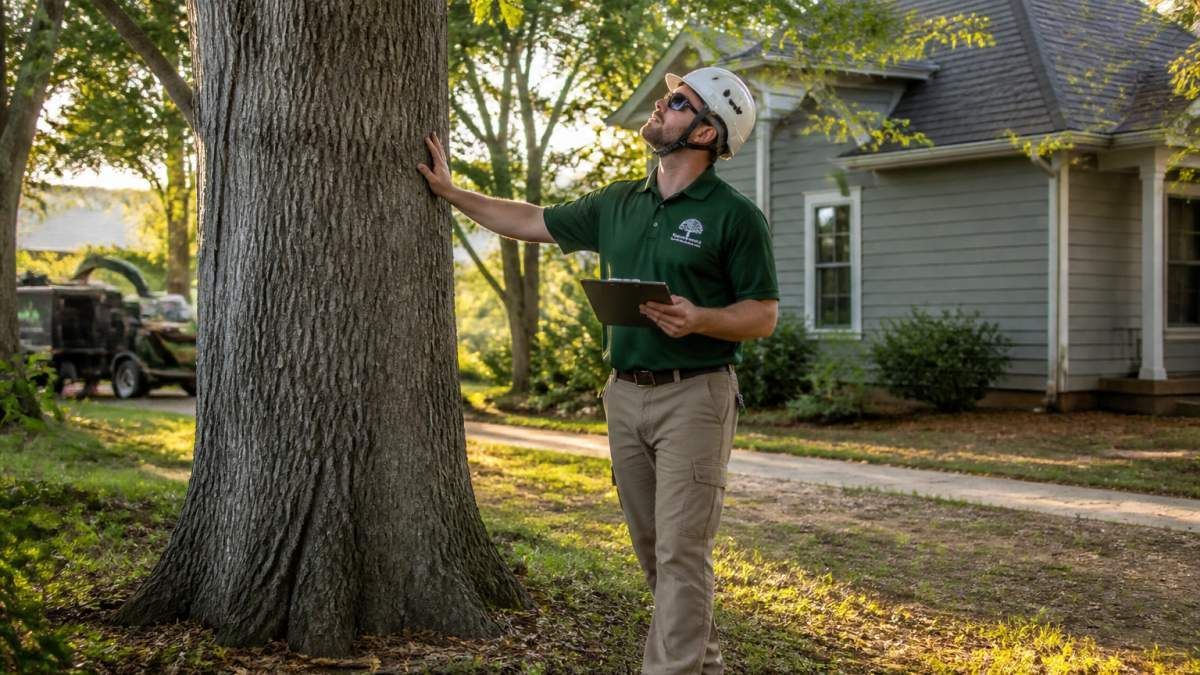
We look for decay, structural integrity, pest activity, and how the tree is weighted. You can book a professional tree health assessment to get details on scheduling one for your property.
Safety Risks, Roof Clearance, and Power Lines
Safety is where trimming and removal stop being a preference and become a requirement. Overgrown branches over a roof, limbs rubbing power lines, and dead wood hanging above a driveway are all hazards that get worse with every storm.
Never trim near power lines yourself. Storm damage turns a manageable limb into an emergency, which is why we also handle emergency tree services when weather hits.
Cost Factors and What Drives Your Estimate
Pricing depends on the job, not a flat rate, and any honest estimate reflects that. Two trees of the same height can carry very different price tags depending on where they sit and what condition they are in. Understanding the variables helps you read an estimate, compare quotes fairly, and avoid the lowball that turns into a change order halfway through the job. Our average cost of tree trimming guide explains what drives trimming estimates.
Here is what actually moves the number.
Tree size and height
Height and trunk diameter are the starting point. A small ornamental in an open yard is a fundamentally different job from a mature hardwood that towers over a house. Bigger trees mean more wood to cut, more weight to control, and more rigging to bring sections down safely.
Access and work-zone setup
This is the variable homeowners most often underestimate. A tree with a clear driveway or open side yard gives a crew room to work and to drop material. A tree hemmed in by a fence, a shed, a pool, or a tight gate changes the whole approach, sections may have to be rigged and lowered by rope rather than dropped, which takes more time and more hands.
Proximity to structures and lines
A tree leaning over a roof, a garage, a power drop, or a neighbor's property line requires controlled sectional removal. The closer the target, the more careful, and more involved, the takedown. Limbs near utility lines are a separate category entirely and belong to the utility or a qualified professional, never a DIY project.
Tree condition and species
A dead, hollow, or storm-damaged tree is often more dangerous to work on than a healthy one, because the wood can fail unpredictably under load. Species matters too: some woods are heavier, some are more brittle, and some have growth habits that make rigging trickier.
Trimming versus full removal
A trimming job that removes a handful of limbs is usually a smaller scope than a full takedown, but not always, a large canopy that needs extensive corrective pruning across many branches can approach removal-level labor. The scope of cuts, not just the label, drives the estimate.
Debris hauling and cleanup
Hauling is real work and real cost. The volume of brush and wood, the distance to the truck, and whether the material has to be chipped and loaded all factor in. Cleanup, raking, blowing, and leaving the yard tidy, is part of a professional job, not an add-on.
What to ask when you compare estimates
- Does the quote include debris hauling and full cleanup?
- Is the price firm, or are there conditions that could change it?
- Is the crew insured, and who is supervising the work?
- What is the plan for protecting the roof, fence, and landscaping during the job?
Because those factors vary so much from property to property, we quote each job individually rather than guessing over the phone. For a clearer picture of what drives trimming estimates, we will walk you through the specifics of your yard.
| Situation | Likely Path | Why |
|---|---|---|
| Dead or hollow trunk | Removal | Structural integrity is compromised |
| Overgrown canopy near roof | Trimming | Restores clearance, preserves the tree |
| Sudden lean after a storm | Assessment, often removal | Possible root or trunk failure |
| Crossing limbs near power lines | Professional trimming | Safety hazard, not DIY |
| Diseased but salvageable tree | Trimming and care | Supports tree health and longevity |
What Happens During Professional Trimming or Removal
A professional job starts with a walk-through and a plan. For trimming, the crew makes selective cuts to shape the canopy and remove hazardous limbs, then cleans up.
Debris removal and cleanup are part of the job, not an afterthought. Most residential work is completed in a single visit, though large or complex removals can take longer.
Request a Tree Care Estimate in Anderson
The hardest part of tree trimming vs tree removal is often just deciding which one you need, and that decision is easier with trained eyes on your property.
We handle trimming, pruning, hazardous removals, and storm cleanup, and we will tell you honestly whether your tree can be saved. Visit our contact page to request your estimate.
Frequently Asked Questions
Is tree trimming cheaper than tree removal?
Trimming is generally less expensive than full removal because it takes less time, equipment, and debris hauling. Removal involves rigging, controlled sectioning, and transporting the whole tree off site. Exact pricing depends on tree size, accessibility, and how close the tree sits to structures or power lines. Arbortech of Anderson provides a written estimate so you know the scope before any work begins.
What months should you not trim trees?
Avoid heavy pruning in early spring when buds are opening and in the weeks after a hard freeze. For most Upstate South Carolina species, late winter dormancy is ideal for structural pruning, and light deadwood removal is fine year-round. Flowering trees are best trimmed right after bloom. A tree health assessment can confirm the right window for your specific species.
Can trimming save a damaged or unhealthy tree?
Sometimes. If the damage is limited to dead, diseased, or crossing branches and the trunk and main structure are sound, selective pruning can restore form and reduce the risk of further failure. If decay has reached the trunk or the root plate is compromised, trimming only delays the inevitable and may increase hazard. A professional assessment tells you which situation you have.
How can you tell if a tree is hazardous?
Watch for a leaning trunk that has shifted recently, cracks or seams in the trunk, mushrooms at the base, hollow sound when tapped, dead limbs in the canopy, and soil heaving on one side. Storm damage, including split leaders and hanging limbs, raises risk immediately. Hazardous trees near a home, driveway, or power line should be assessed by a professional tree service before the next storm.