Trees can show signs of disease long before they become a serious safety concern. Knowing what to look for can help homeowners identify potential problems early and determine when professional tree care may be needed.
At Arbortech of Anderson , we've been serving Anderson, SC, and surrounding Upstate South Carolina communities since 2008. From tree health concerns to hazardous tree removal and professional pruning, our team helps property owners make informed decisions about their trees. Here are some common warning signs to watch for.
Start With a Tree Health Assessment From the Ground Up
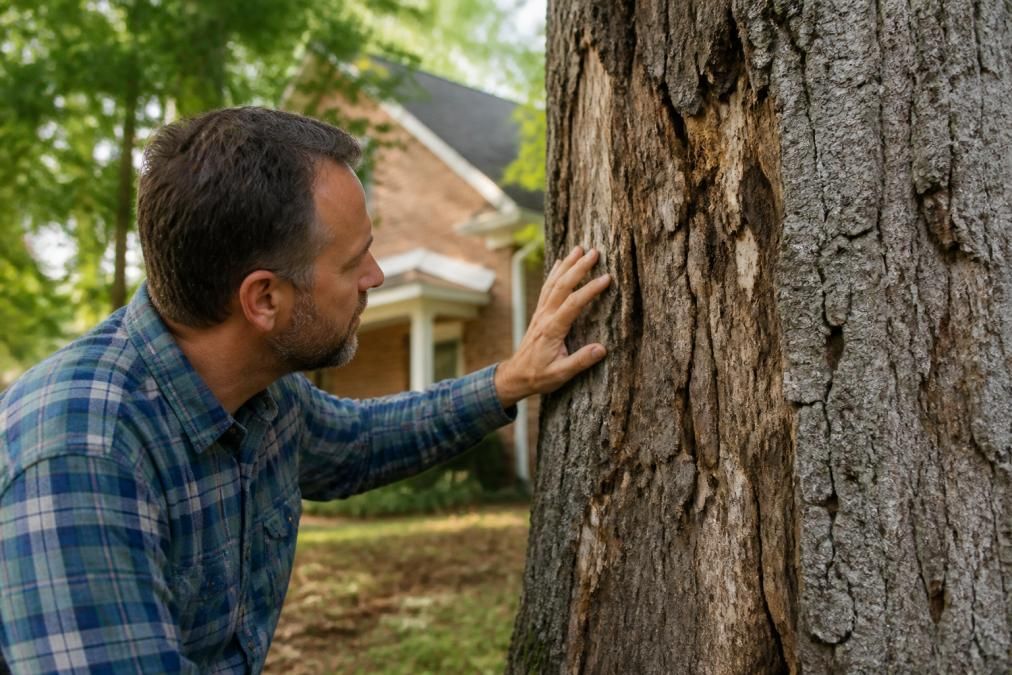
Learning how to identify diseased trees starts with a slow walk around the trunk. Most problems show up low before they show up high. Our crews assess trees the same way every time: roots first, then trunk, then canopy.
Here is the order that works:
- Roots and soil: Look for mushrooms, soft ground, or exposed roots
- Trunk: Check for cracks, oozing sap, or missing bark
- Canopy: Note thin spots, dead branches, or off-color leaves
- Lean: Compare the tree to its neighbors
Signs of a Dying Tree: What to Look For First
The clearest signs of a dying tree are a thinning canopy, dead branches at the top, and bark that peels or cracks. One dead branch is normal. A pattern of decline across the whole tree is not.
Leaf Discoloration, Spotting, and Defoliation
Off-color leaves are the most common early warning. Chlorosis is yellowing caused by poor nutrient uptake or disease, and it often shows up first along the leaf veins.
Watch for these leaf symptoms:
- Yellow or pale leaves when neighbors are green
- Brown spots or blotches that spread
- Curling or wilting despite regular water
- Leaves dropping in summer, not fall
Bark Abnormalities, Splitting, and Cankers
Bark tells you what is happening underneath. A canker is a dead, sunken patch of bark, often with a dark or oozing edge. Cankers cut off the flow of water and nutrients inside the tree.
Look for:
- Vertical cracks in the trunk
- Sunken or discolored patches
- Peeling bark that exposes bare wood
- Dark sap or exudate running down the trunk
How to Identify Diseased Trees by Their Roots and Soil
Root problems are the hardest to see and the most dangerous to ignore: a tree with a failing root system can look healthy right up until it falls. Before assuming disease, rule out the two impostors that mimic it, nutrient deficiency and soil-chemistry problems.
Root Rot, Girdling Roots, and Soil Compaction
Three root issues cause most failures homeowners deal with. Each one has a different fix.
| Problem |
What You See |
Why It Matters |
|---|---|---|
| Root rot |
Mushrooms, soft soil, slow growth |
Weakens the base, tree can topple |
| Girdling roots |
Roots circling the trunk base |
Chokes the tree over years |
| Soil compaction |
Hard, bare ground, poor drainage |
Starves roots of air and water |
Disease or Nutrient Deficiency? The Distinction That Saves Money
This is the most common misdiagnosis homeowners make, and it leads to unnecessary fungicide or fertilizer treatments. A tree with yellowing leaves is not automatically diseased.
- Nitrogen deficiency , uniform yellowing of older, lower leaves first; the whole canopy looks pale and growth is stunted.
- Iron deficiency , yellowing between the veins while the veins stay green (interveinal chlorosis), most common on alkaline soils. This is a soil-pH problem, not a disease.
- Magnesium deficiency , yellowing between veins on older leaves, sometimes with reddish margins.
- Manganese deficiency , interveinal chlorosis on younger leaves, often on high-pH soils.
- Symptoms appear on one side of the tree or one branch first, not uniformly.
- Spots, blotches, or cankers have defined edges rather than a smooth gradient.
- The pattern spreads over weeks, not overnight.
- You find fungal bodies, oozing sap, or insect exit holes nearby.
Reading the Root Flare
The root flare is where the trunk widens into the roots. On a healthy tree it sits at or just above grade, flaring outward like a bell. If the trunk goes straight into the ground like a telephone pole, the tree was planted too deep, the most common cause of girdling roots and long-term decline. Excavate gently with a hand trowel; if you dig more than an inch or two, the tree is buried and stressed.
Dieback, Fungal Growth, and Pest Infestation Indicators
Dieback and fungal growth are the two loudest signals a tree is losing the fight. Dieback is the gradual death of twigs and branches, starting at the tips and working inward, but the pattern tells you more than the presence of it.
What Dieback Pattern Tells You
- Top-down dieback (crown thins from the top), often a root or vascular problem; the tree cannot push water to the highest points.
- Outside-in dieback (branch tips die back toward the trunk), commonly environmental stress, drought, or salt damage.
- One-sided dieback , usually a physical injury, a canker, or a root problem on that side.
- Random scattered dead branches , often a pest or a localized canker rather than a systemic issue.
Fungal signs include:
- Shelf mushrooms (conks) on the trunk
- Mycelium , the white, fan-shaped mat of fungal threads, under loose bark
- Black or white patches on wood
Mushrooms at the base of a tree are serious. They mean decay is already inside the trunk. A conk is the fruiting body of a wood-decay fungus; by the time you see it, the fungus has typically been digesting heartwood for years.
Pest Infestation Indicators
Pests leave their own clues: small holes in the bark, sawdust-like frass , and sticky sap. Boring insects tunnel under the bark and cut off the tree's food supply.
| Sign |
Likely Culprit |
What It Means |
|---|---|---|
| D-shaped exit holes |
Emerald ash borer |
Ash trees only; report to your state forestry agency |
| Round holes with sawdust |
Bark beetles, ambrosia beetles |
Often attacks already-stressed trees |
| Fine webbing + stippled leaves |
Spider mites |
Sucking pest; worse in hot, dry weather |
| Sticky residue + black sooty mold |
Aphids, scale |
Honeydew drops feed mold; rarely fatal alone |
| Cottony masses on bark |
Adelgids, scale |
Common on hemlocks and other conifers |
The Diagnostic Decision Path
- Is the dieback uniform or patchy? Uniform points to environment or roots; patchy points to disease or pests.
- Are there fungal bodies? Conks at the base or on the trunk mean internal decay, treat as a structural concern, not just a health one.
- Are there insect signs? Holes, frass, or sap flow point to borers; webbing and stippling point to sucking pests.
- Did symptoms appear suddenly or gradually? Sudden onset usually means a discrete event, a freeze, a storm, a pest outbreak. Gradual decline usually means roots, soil, or a chronic disease.
- Is the tree otherwise vigorous? A healthy tree can often compartmentalize a wound or outgrow a minor infestation. A stressed tree cannot.
If signs match more than one row above, that overlap is itself a clue: trees under chronic stress are far more vulnerable to pests and secondary infections, so the combination often means the underlying problem started with the roots or the soil.
When to Remove a Hazardous Tree: The DIY vs. Professional Threshold
Most sick trees do not need to come down. The question is whether the tree poses a real risk to people or property.
Call a professional when you see any of these:
- Mushrooms at the base or large cavities in the trunk
- A new lean of more than a few degrees
- Cracks in the trunk or major limb unions
- Dead branches hanging over a roof, driveway, or walkway
- Roots that are cut, raised, or damaged
Seasonal Diagnostic Calendar: What to Check Each Season
Tree problems show up on a schedule. Checking at the right time makes them easier to catch.
| Season |
What to Check |
Why Now |
|---|---|---|
| Spring |
New growth, leaf color |
Slow leaf-out signals stress |
| Summer |
Canopy density, pests |
Insects and disease peak |
| Fall |
Early leaf drop, fungi |
Mushrooms appear after rain |
| Winter |
Bark, structure, lean |
Bare trees show cracks and splits |
Professional Tree Health Assessment: What an Arborist Checks
An arborist looks at things a homeowner cannot see from the ground, covering the whole tree, not just the part that looks sick.
A trained eye checks:
- Cambium layer health under the bark
- Vascular wilt and other internal disease
- Structural integrity of the trunk and main limbs
- Canopy density and crown thinning patterns
- Root flare and signs of girdling roots
Frequently Asked Questions
How to tell if a tree is diseased or dying?
Look for a combination of symptoms: leaf discoloration or early drop, bark that is cracked, peeling, or oozing, dead branches in the upper canopy, and fungal growth at the base. A single symptom may be environmental stress, but three or more together usually point to disease. Check the trunk for soft spots or hollow sounds when tapped.
Can a tree recover from disease or fungal infection?
Some diseases are treatable if caught early. Fungal leaf spots and minor cankers often respond to pruning and improved air circulation. However, vascular wilts and advanced root rot usually cannot be cured. A professional tree health assessment can determine whether treatment is realistic or if removal is the safer option.
When should you call a professional for tree removal?
Call a professional when a diseased tree leans more than 15 degrees, has large dead limbs over structures, shows fungal conks at the base, or has cracks in the main trunk. These are signs of structural failure. If the tree is within falling distance of your home or power lines, do not attempt removal yourself.
What are the most common signs of tree stress?
Common signs include sparse canopy, yellowing leaves (chlorosis), premature leaf drop, and small leaves. Environmental stress from drought, soil compaction, or poor drainage can mimic disease. A tree health assessment helps separate stress from active infection.
If you're concerned about the health or safety of a tree on your property, Arbortech of Anderson is here to help. We've proudly served Anderson and surrounding Upstate South Carolina communities since 2008. Whether you're dealing with a declining tree, hazardous limbs, or a tree that may need removal, contact our team to discuss your concerns and schedule an estimate.