Last Updated: October 28, 2026
Quick Summary
An emergency tree service responds when a tree threatens people, a home, or power lines right now, such as a tree on a structure, blocking a driveway, or hanging over a road. Call a professional tree service right away rather than waiting. Describe what is threatened so crews can triage your call.
- Treat a tree as an emergency if it could hurt someone or cause damage in the next few hours.
- Stay away from power lines and assume every line is live.
- Photograph damage from a safe distance before anything is moved.
- Confirm a tree service carries liability insurance and workers' compensation before work begins.
- Do not cut a tree that is pinned on your home, since removing tension can cause more damage.
When an Emergency Tree Service Call Is Necessary
A tree becomes an emergency when it threatens people, a home, or power lines right now. Most storm-related calls come in after high winds, heavy rain, or ice has loosened a limb or root system. If a tree is on a structure, blocking a driveway, or hanging over a road, do not wait. Call a professional tree service right away.
Not every problem needs a same-day crew. A cracked branch hanging over an empty yard can usually wait for a scheduled visit. The question to ask is simple: could this tree hurt someone or cause damage in the next few hours? If the answer is yes, treat it as an emergency.
Emergency tree services cover the situations that cannot wait: trees on homes, vehicles, or fences, limbs threatening power lines, and trees blocking access for emergency vehicles. If you are unsure, call and describe what you see.
Signs a Tree Is Dangerous Before It Fails
Most trees give warning signs before they come down. Learning to spot them can keep you and your property safe. Start by walking the perimeter of the tree and looking up at the canopy from several angles.
Leaning Trees and Recent Ground Movement
A tree that has started leaning, especially if the lean is new, deserves attention. Look for soil heaving or cracks near the base, and for roots lifting out of the ground on the side opposite the lean. Recent ground movement after heavy rain is a common sign that the root system has lost its hold. If you see any of these, keep people and pets away from the area and call for an assessment.
Cracks, Splits and Dead Limbs Overhead
Cracks in the trunk, deep splits where branches meet the main stem, and dead limbs in the canopy all signal weakness. Dead branches are often brittle and can fall without any warning, even on calm days. Look for fungal growth, peeling bark, or cavities at the base of the trunk, since these can point to internal decay. Do not try to inspect high branches yourself.
What to Do if a Tree Falls on Your House
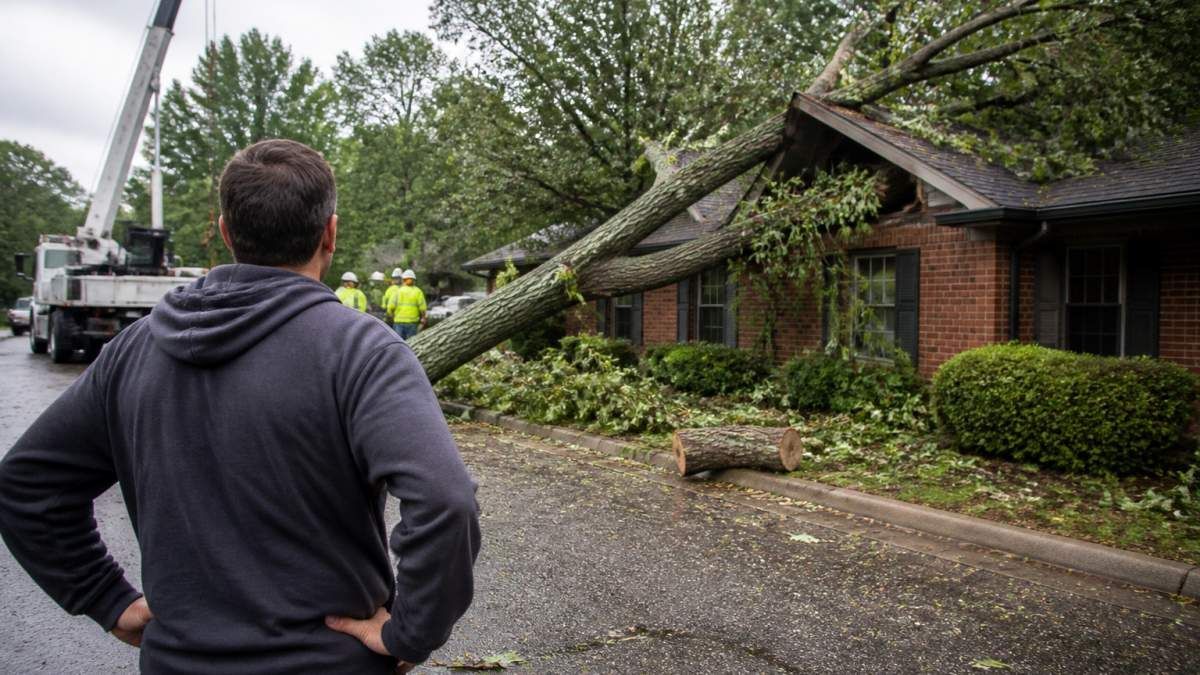
A tree on your home is frightening, but your first priority is safety. Get everyone out of the building and move to a clear area away from the tree and any downed power lines. If anyone is injured, call 911 before anything else.
Once everyone is safe, take these steps:
- Stay away from power lines. Assume every line is live, and report downed lines to your utility company.
- Do not go back inside until emergency responders confirm the structure is safe.
- Photograph the damage from a safe distance before anything is moved. This documentation matters for your insurance claim.
- Call your insurance company to report the loss and ask about emergency mitigation coverage.
- Call a licensed tree service with emergency experience. Confirm they carry liability insurance and workers' compensation before work begins.
Do not attempt to cut or remove a tree that is pinned on your home. Removing a tree under tension can cause it to shift and cause more damage or injury.
Tree Touching Power Lines: Stay Back and Call the Utility
A tree touching a power line is one of the most dangerous situations a homeowner can face. Electricity can travel through wet branches, the ground, and even the tree trunk. Keep away from any tree in contact with a line, and keep others back as well. Do not touch the tree, and do not attempt to pull branches off the line.
Contact your local utility company immediately. Utility crews handle energized lines, and they are the only ones who should work near them. Once the utility has cleared the line, a tree service can handle the branches and cleanup.
Emergency Tree Service Response Time and What Affects It
Response time after a storm is not one number. It is the output of a triage process, and understanding that process helps you set realistic expectations and advocate for your property.
How crews triage calls
When you call, describe the situation in those terms. Saying "a tree is on my roof and water is coming in" moves you up the list faster than "a tree came down." Be specific about what is threatened, whether anyone is injured, and whether access is blocked.
What actually slows a crew down
- Road access. Blocked streets, downed lines across a driveway, and flooded low spots all delay arrival. If you can safely clear a path for a truck, say so when you call.
What to have ready when you call
- Your address and the nearest cross street
- A one-sentence description of the hazard and what it threatens
- Photos taken from a safe distance
- Whether anyone is injured or trapped
- Whether the utility has been called and whether the line is still energized
- A callback number and someone on site who can authorize work
Ask for an arrival window and a callback if the crew is delayed.
At Arbortech of Anderson, our family-owned team has served Anderson and the surrounding Upstate since 2008.
The factors that most affect how quickly a crew reaches you are summarized below.
| Factor | Effect on response | What you can do |
|---|---|---|
| Road access | Blocked streets and downed lines delay arrival | Clear a safe path for a truck if you can |
| Call description | Specific hazards move you up the list faster | Say what is threatened and whether anyone is injured |
| Injury or trapped people | Life-safety calls take priority | State it clearly at the start of the call |
| Utility line status | Crews wait until lines are cleared | Confirm whether the line is still energized |
| Photos | Help crews triage before arriving | Take photos from a safe distance |
| Callback number | Keeps the crew able to reach you | Give a number and an on-site contact |
Insurance, Documentation and Working With Your Emergency Crew
This is where most homeowners get surprised. Emergency tree work and insurance coverage do not line up as neatly as people expect, and the difference between a reimbursed claim and an out-of-pocket bill often comes down to a few distinctions made before the crew arrives.
How homeowners insurance usually treats emergency tree removal
Policy wording varies, and your own policy controls. That said, a few common patterns show up across most homeowners policies:
- Tree hits an insured structure. If a tree falls on your home, garage, shed, or fence, removal of the tree from the structure is often covered as part of the damage claim, subject to your deductible and policy limits.
- Tree blocks access or a driveway. Coverage here is inconsistent. Some policies pay to remove a tree that blocks a driveway or ramp needed for access; others treat it as a maintenance item. Read the removal-of-trees section of your policy.
- Tree falls in the open yard without hitting anything. This is the most common surprise. Many policies limit or exclude removal of a tree that fell without damaging a covered structure, even if the tree was large and the cleanup is expensive.
- Preventive removal of a hazardous tree. Removing a tree before it falls is usually treated as homeowner maintenance, not a covered loss, unless a covered peril (such as a storm) already caused the damage that made the tree hazardous.
- Debris hauling. Some policies cap what they will pay for debris removal, and the cap may be separate from the tree removal limit.
Urgency does not create coverage. A crew arriving at 2 a.m. does not change what your policy says. That is why the documentation steps below matter so much.
Who authorizes the work
Before any crew starts, clarify who is authorizing the job and on what terms:
Documentation and claim-filing checklist
Build this file before, during, and after the work:
- Photos and video of the tree and damage from multiple angles, taken before anything is moved
- The date and time the damage occurred and when you discovered it
- Your claim number and the adjuster's name, phone, and email
- A written scope of work and price from the tree service, signed before work begins
- Invoices and receipts for the work performed
- Receipts for any emergency repairs you made to prevent further damage, such as tarps or temporary bracing
- A log of calls and messages with your insurer and the tree service
- The certificate of insurance the tree service provided
Keep originals and a digital backup. Adjusters move quickly after a major storm, and a clean file speeds the process.
Verify the contractor before work begins
At Arbortech of Anderson, our family-owned team has served Anderson and the Upstate since 2008.
Get Emergency Help From Arbortech of Anderson
When a tree threatens your home, family, or property, you need a crew you can trust to respond with care and professionalism. Arbortech of Anderson is a locally owned, family-operated tree service serving Anderson, Clemson, Easley, Greenville, and surrounding Upstate communities. We handle emergency tree removal, hazardous tree removal, and storm damage cleanup.
If you are facing an urgent tree situation, contact Arbortech of Anderson for an estimate.
Frequently Asked Questions
When should I call an emergency tree service?
Call an emergency tree service right away if a tree has fallen on a structure, a vehicle, or a power line, if a large limb is hanging over a home or driveway, or if a tree is leaning suddenly after a storm. Cracks at the base, soil heaving around the roots, and split trunks also justify a same-day call. Do not wait to see whether conditions get worse. Staying clear of the hazard and contacting a professional quickly reduces the risk of injury and additional damage. Arbortech of Anderson can assess the situation and advise on the safest next step.
What should I do if a tree falls on my house?
First, check that everyone inside is safe and get out if there is any sign of structural shifting, gas odor or water leaks. Stay away from downed power lines and call 911 if anyone is hurt or trapped. Then contact your insurer and an emergency tree service to secure the tree. Photograph the damage before anything is moved, and avoid climbing onto the roof or pulling on the trunk yourself. A professional crew can remove the tree in a controlled way.
Does homeowners insurance cover emergency tree removal?
Coverage depends on your policy and the circumstances, so there is no single answer that applies to every claim. Many policies address trees that fall on a dwelling, but coverage for removing a tree that has not caused damage can differ. Document the damage, keep receipts, and ask your insurer before authorizing work when you can. Your agent can explain how your specific policy treats emergency tree removal.
What should I do if a tree is touching a power line?
Treat any tree in contact with a power line as energized. Keep yourself and others at least 35 feet away, do not touch the tree or any wire, and call your utility company and 911. Only the utility or a qualified crew working with them should approach the line. Once the power company confirms the line is safe, an emergency tree service can remove the hazard.