Last Updated: October 20, 2026
Emergency Tree Removal Cost in 2026: The Factors That Drive the Bill
Emergency tree removal is the unplanned removal of a tree that poses an immediate threat to people or property, usually after a storm, a split trunk, or a sudden lean.
Below, we break down what pushes costs up, what you can check safely on your own, and how to keep the final bill as low as the situation allows. But first: most guides treat every downed tree as an emergency.
Why Two Quotes for the Same Tree Can Differ by Thousands
Two crews can look at the same tree and quote very different numbers. That gap is not always upselling, it usually comes from how each crew plans the job. A tree leaning over a fence is a different job than one hanging over a roof, and the equipment, rigging, and crew risk all change.
Here is what moves the number most:
- Proximity to structures. Trees near homes, garages, and power lines take more care and time.
- Size and species. A tall pine with heavy limbs is not the same as a small ornamental.
- Access. A tree in an open yard is easier than one behind a gate or between buildings.
Ask each provider to explain their plan. A clear plan is a fair plan.
What Triggers an Emergency Tree Service Call
An emergency tree service call is warranted when a tree has failed or is about to fail and something valuable sits in its path.
Common triggers we see:
- A tree or large limb already down on a roof, fence, or driveway
- A trunk split that is still standing
- A tree leaning toward a house after heavy rain
If a tree is down on a power line, stop and call your utility first. Never approach it.
Urgency Levels: When It Cannot Wait Until Monday
Not every call needs a same-day crew. Sorting your situation into a level helps you decide how fast to act.
| Urgency Level | What It Looks Like | What To Do |
|---|---|---|
| Immediate | Tree on a structure, blocking a road, or on a power line | Call for emergency help now; keep everyone clear |
| Same day | Split trunk, fresh lean toward a home, hanging limb overhead | Call today; keep the area clear until a crew arrives |
| This week | Dead tree near a target, cracked limb, visible decay | Schedule an assessment soon |
| Monitor | Minor deadwood, small cracks, no target nearby | Watch it and recheck each season |
When in doubt, treat it as higher urgency. A short wait costs nothing. A missed warning sign can cost a lot.
Storm Damage Tree Removal: Why Storm Work Costs More
Storm damage tree removal costs more than routine work because the job is harder and riskier. Storm-damaged trees are unpredictable, and crews often work in wet, unstable conditions.
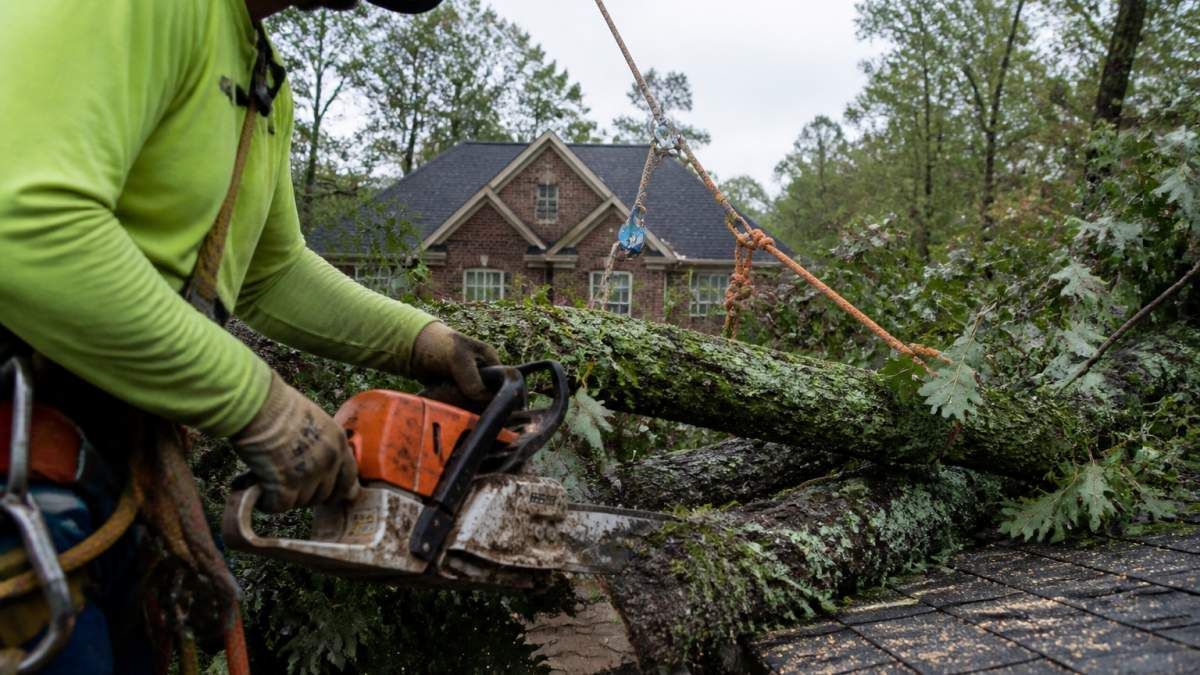
After a storm, several things change at once:
- Tension and pressure. Limbs under load can snap when cut. Crews use rigging to control the fall.
- Unstable ground. Saturated soil makes equipment work and footing riskier.
- Volume. Storm cleanup means more debris, more trips, and more labor.
That is why a storm call is not the same as a scheduled removal. The work is planned around safety, not speed alone.
Does Tree Damage Homeowners Insurance Cover the Removal?
Homeowners insurance often covers tree removal when a tree hits a covered structure, like your home, garage, or fence. Coverage is less predictable when a tree falls in an open yard and hits nothing.
The Insurance Information Institute's guide to homeowners insurance explains that policies vary widely, so read your own policy or call your agent before assuming.
A simple way to think about it:
- Tree hits your house or a covered structure: removal is often at least partly covered.
- Tree blocks your driveway but hits nothing: coverage is less certain.
- Tree was already dead or diseased before the storm: many policies limit or exclude this.
Document everything: photos before cleanup, receipts, and any arborist notes. Clear records make claims smoother.
Signs of Root Rot in Backyard Trees You Can Check Yourself
Signs of root rot in backyard trees include a thinning canopy, mushrooms or fungal growth at the base, soft or sunken soil near the trunk, and a tree that suddenly leans. Root problems often show up above ground before the tree fails, weakening the anchor that holds it upright. That is why a consistent inspection order matters: canopy first, then trunk, then root zone, and finally what the tree could hit.
A Repeatable Inspection Order
Run this sequence from a safe distance, ideally from the sidewalk or the edge of the yard, never from under the tree.
- Canopy. Look for thinning foliage, dead branches, and dieback at the tips. Compare the tree to nearby trees of the same species.
- Trunk. Look for cracks, splits, cavities, and fungal growth such as conks or mushrooms on the bark.
- Root zone. Look for mushrooms near the trunk, soft or sunken soil, exposed roots, and soil heaving on the side away from the lean.
- Lean. Check whether the tree has changed its lean since you last looked. A new lean, especially after heavy rain, is a serious sign.
- Target. Look at what sits in the fall zone: a house, a car, a fence, a power line, or a spot where people gather.
Look for these clues as you go:
- Fungal growth at the base or along roots
- Mushrooms sprouting near the trunk
- Soft, spongy, or sunken soil around the base
Hazard Versus Risk in the Root Zone
A hazard tree has a structural defect. Risk is that defect combined with a target, meaning people or property that could be hit. A tree with root rot in an empty field is a hazard.
That distinction is the single biggest factor in what a job costs and how urgently it gets handled. A defect with a target nearby gets priority and more careful, costly work.
What Homeowners Can Safely Assess vs. What Needs an Arborist
You can safely check for visible signs from a distance. You cannot safely judge how much sound wood is left inside a trunk or how much root holds the tree in place.
What you can do:
- Look for mushrooms and fungal growth
- Note any new lean
- Check the canopy for thinning or dead branches
What needs a professional:
- Judging decay inside the trunk
- Assessing root stability
- Deciding whether a tree can be saved
- Planning a safe removal near structures
A common mistake is poking or cutting into a suspect trunk to "test" it. That can weaken the tree and put you underneath it. Another is digging around the base to check the roots, which can damage the very roots holding the tree up.
Documentation and Monitoring Over Time
Root rot is often slow, and changes are easy to miss. Take photos from the same spot each season, note the date, and record anything that changes: a new lean, a new mushroom, a widening crack. Those notes help you track deterioration and give a professional a clearer picture when you call.
If you are in Anderson or a nearby community like Belton, Pendleton, or Williamston and are not sure what you are seeing, a professional assessment is the safest next step. Arbortech of Anderson has served the Upstate since 2008, and we can look at the canopy, trunk, and root zone and tell you what we see.
Hazard vs. Risk: The Inspection Checklist That Decides the Price
A hazard tree has a structural defect. Risk is that defect combined with a target, meaning people or property that could be hit. A tree with a crack in an empty field is a hazard; the same tree over a driveway is a real risk.
Here is a simple checklist you can run from a safe distance:
- Is there a crack, split, or cavity in the trunk?
- Are there dead, broken, or hanging branches overhead?
- Is there fungal growth or a conk on the trunk?
- Has the tree started to lean, or changed its lean?
The more boxes you check, the higher the risk and the sooner you should call. This checklist also helps a crew price the job fairly, because it shows exactly what they are working around.
How to Keep Emergency Tree Removal Costs Down
You cannot control the storm, but you can control how prepared you are.
- Get a routine inspection. A seasonal check catches problems before they become emergencies.
- Handle small issues early. A cracked limb caught early is a smaller job than a fallen one.
- Keep access clear. Make sure crews can reach your trees without moving vehicles or fences.
- Document your trees. Photos and notes help with insurance and planning.
We also recommend asking any provider about insurance and how they handle the work. OSHA's tree care industry guidance outlines the safety standards professional crews follow, which is a fair thing to ask about.
At Arbortech of Anderson, we are family owned and have served Anderson and the surrounding Upstate communities since 2008.
Emergencies rarely announce themselves, and the cost of waiting is often higher than the cost of a call.
Frequently Asked Questions
What factors affect the cost of emergency tree removal?
The biggest drivers are tree size and height, how close it sits to a house, fence, or power lines, whether it is already leaning or split, and how accessible the site is for equipment. A tree that fell across a driveway is usually simpler to handle than one hung up over a roof. Time of day and weather also matter, since after-hours and storm-response work takes more crew coordination. Because every property is different, Arbortech of Anderson gives an on-site estimate rather than quoting a flat rate over the phone.
Does homeowners insurance cover emergency tree removal?
Tree damage homeowners insurance usually covers removal when the tree hits a covered structure, like your house, garage, or fence. If a tree falls in the yard and hits nothing, many policies cover only a limited amount for debris removal, and some cover none. Document the damage with photos before anything is moved, call your insurer, and keep every receipt. Coverage and limits vary by policy, so confirm the details with your agent before assuming the work is reimbursed.
How quickly can an emergency tree service respond?
Response time depends on storm volume and road conditions. A local crew can often reach an active hazard the same day, while a widespread storm event may push non-urgent calls back a day or two. When you call, describe the situation clearly: is the tree on a structure, blocking a driveway, or near a power line? That helps the dispatcher set priority. Arbortech of Anderson has handled emergency tree service across the Upstate since 2008 and can tell you realistic timing when you call.
What should I do if a tree falls on my house?
Get everyone out of the affected rooms and call 911 if there is any chance of injury, a gas smell, or downed power lines. Do not go near the tree if lines are involved. Once the area is safe, photograph the damage from a distance for your insurance claim, then call a tree service to assess removal. Keep people and pets away from the structure until a professional confirms it is stable. Arbortech of Anderson can assess the tree and coordinate safe removal.
Can a damaged tree be saved, or does it need to be removed?
It depends on the type of damage and how much sound wood remains. A tree with one broken limb and an intact trunk often recovers with proper pruning. A tree with a split trunk, major bark loss around the base, or signs of root rot in backyard trees is a different story and may need removal to protect the house. An arborist can inspect the structural defect and give you an honest answer, including when trimming is the better option.