
Last Updated: October 20, 2026
What the Average Cost of Tree Trimming Really Reflects
The average cost of tree trimming is a starting point, not a quote. It describes what homeowners typically pay for a routine job on a moderate-sized tree, and tells you little about what your oak, pine, or maple will need.
Tree trimming is the selective removal of branches to manage size, clearance, and shape, while tree pruning is the targeted removal of dead, damaged, or structurally weak growth to protect the tree's long-term health. The two overlap on most jobs, and a written estimate should tell you which one you're paying for.
What most pricing guides miss is that the number on the invoice is assembled from a handful of moving parts: labor hours, crew size, equipment, and debris disposal. Change any one and the total shifts.
Tree Trimming Cost Factors That Move the Price Most
No single variable drives tree trimming cost factors harder than the size and condition of the tree in front of the crew. A small ornamental in an open lawn is a morning's work; a mature hardwood leaning over a roofline is a different category of job entirely.
Size and Height
Tree height is the first thing any estimator measures, and it scales the work faster than most homeowners expect. A small tree under roughly 25 feet can often be handled with pole saws and ladders.
Trimming cost rises in steps rather than a straight line: two trees of similar height can land in different categories if one requires a lift and the other can be worked from the ground and a ladder.
Species and Wood Density
Species matters just as much as height. Hardwoods with dense wood and heavy limbs take longer to cut and control than softwoods, and some species demand timing discipline, since trimming at the wrong point in the year can invite pests or disease.
Condition and Structural Risk
Condition is the factor homeowners underestimate. A tree with deadwood, included bark, or a split crotch requires slower, more careful work because every cut changes how the remaining structure carries load. That caution costs time, and time is the largest line on any estimate, which is why a walkthrough matters more than a phone quote.
Access, Obstacles, and Risk
Access is where two quotes for the "same" tree can diverge sharply.
Proximity to power lines raises the stakes again. Utility-line work is not a job for a homeowner with a pole saw, nor one every tree service is equipped to take on.
Nearby structures, sloped ground, and soft turf all add handling time. So does the cleanup: hauling brush and wood out of a tight side yard takes longer than chipping it at the curb.
Pruning Scope and Standards
What the crew is asked to remove changes the price as much as the tree itself. Crown thinning, crown raising, deadwood removal, and clearance pruning are different scopes with different time requirements, and a bid that says only "trim tree" leaves the most important variable undefined.
Good pruning follows established practice: cuts are made at the branch collar, no more than a modest share of the live crown is removed in a single visit, and the goal is structural health rather than a uniform shape.
What Belongs in a Tree Trimming Estimate
Once you understand the structure of an estimate, you can read any bid, ours or another provider's, and spot what is missing.
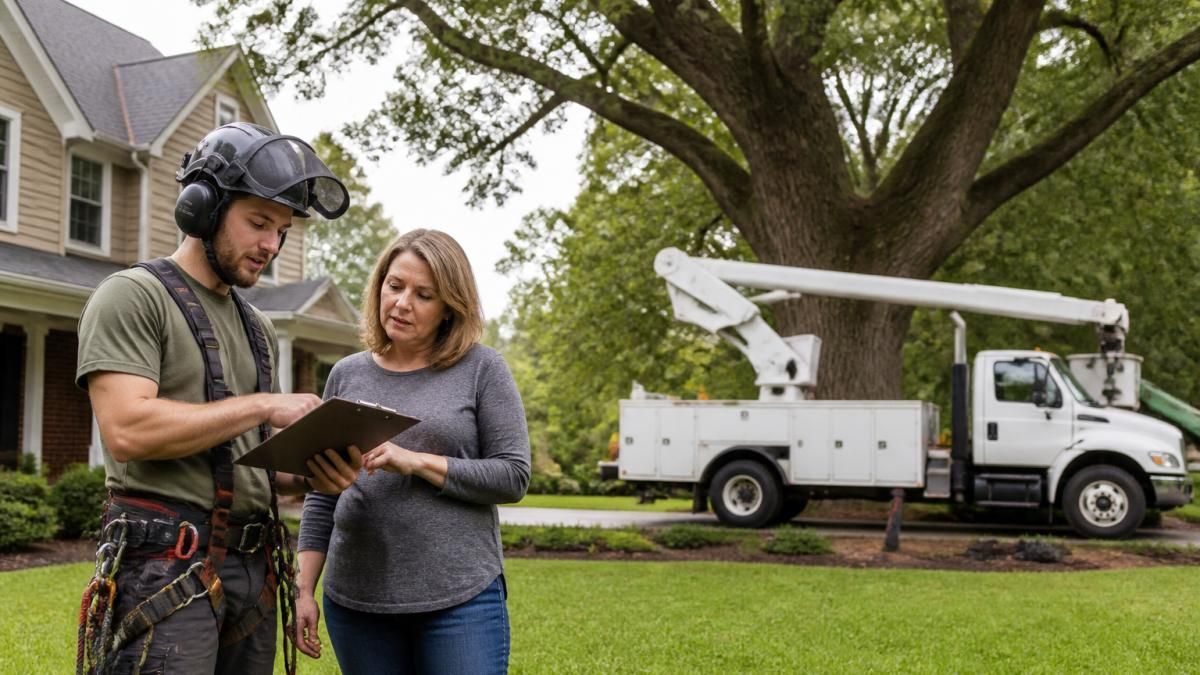
The Four Line Items Behind Every Trimming Estimate
Nearly every professional trimming estimate is built from the same four components, whether itemized or rolled into one number:
- Labor. Crew size multiplied by hours on site. A two-person and a four-person crew working the same tree produce very different totals, and the larger crew is not automatically the more expensive job, it often finishes in half the time.
- Equipment. Climbing gear, ropes and rigging, a chipper, and sometimes a bucket truck or lift. Equipment brought in for a single difficult tree adds to the job in a way a straightforward removal from an open lawn does not.
- Disposal. Chipping, hauling, and tipping fees for the brush and wood. Disposal is frequently the line homeowners forget to ask about, and it is the one most likely to be excluded from a low bid.
A Sample Estimate, Itemized
Consider a representative job: a mature hardwood roughly 40 feet tall in a fenced backyard with a shed on one side and a driveway on the other, with a scope of crown raising over the shed, deadwood removal, and clearance over the drive. A professional estimate typically breaks down along these lines:
| Line Item | What It Covers |
|---|---|
| Labor | Three-person crew, most of a day, including a climber and two ground crew |
| Equipment | Chipper, climbing and rigging gear, ropes and lowering devices |
| Disposal | Chipping on site, hauling brush and wood, tipping fees |
| Access handling | Rigging and lowering every limb rather than dropping it, due to the fence and shed |
| Cleanup | Raking and blowing the work area, removing sawdust and small debris |
Notice what is not on that list: a mystery line for "miscellaneous." A legitimate estimate names what the crew will do and what it will cost. When a bid arrives as a single number with no breakdown, ask for the breakdown first.
Reading the Estimate Like a Homeowner
Here is the checklist we would use to read any estimate, including one from another provider:
- Property address and the date of the walkthrough
- Each tree identified by location and approximate height
- Scope stated in plain language: crown thinning, crown raising, deadwood removal, or clearance over a structure
That list is also the fastest way to spot a lowball bid. A quote that names a total but no scope is not a bargain, it is an opening position. Expect the final invoice to grow once the crew finds deadwood the estimator never climbed up to see.
Ask the estimator to mark the trees on site and note the specific limbs being removed. A scope you can point to is a scope a crew can be held to, and it removes the "we thought you wanted more taken off" conversation entirely.
How Often to Trim Trees on an Upstate South Carolina Property
Most established shade trees on a residential property need trimming every three to five years, with faster-growing species on the shorter end and slow growers stretched further out.
How often to trim trees is really a question about growth rate and your tolerance for risk.
Watch for the signals that reset the clock:
- Limbs encroaching on the roof, siding, or chimney
- Deadwood visible in the canopy
- Suckers sprouting heavily from the trunk or main limbs
Upstate summers bring heavy storms, and a canopy that has gone untended for a decade catches far more wind than one maintained on schedule.
The Best Time to Trim Trees in the Upstate
Late winter, while trees are dormant and before spring growth pushes out, is generally the best time to trim most species in this region.
That said, dormancy is a guideline, not a law. Dead, damaged, or hazardous limbs come off whenever they pose a risk, regardless of the season.
A few timing notes worth knowing before you schedule:
- Avoid heavy pruning right after bud break , when the tree is spending energy on new growth.
- Spring-flowering trees are usually pruned after they bloom so you don't cut off the season's flowers.
- Oaks in the South carry a specific concern about timing tied to pest activity, so ask your arborist about the right window for your species.
If you are unsure which category your trees fall into, a walkthrough settles it quickly. Our tree pruning crews assess species, structure, and timing on site rather than working from a generic calendar.
Comparing Tree Trimming Quotes Without Getting Burned
The lowest bid is not the cheapest job. Compare tree trimming quotes on scope, insurance, and crew qualifications first, and treat price as the last filter rather than the first.
Here is how we would sort three bids on the same tree:
| What to Check | Red Flag | What Good Looks Like |
|---|---|---|
| Written scope | "Trim tree as needed" | Named limbs, height, and clearance target |
| Insurance | "We're covered" with no certificate | Certificate of insurance on request |
| Debris | Left in the yard, unmentioned | Removal and disposal stated clearly |
| Crew and equipment | No details given | Crew size and equipment named |
| Timing | "Sometime next month" | Start window in writing |
| Payment | Large cash deposit upfront | Reasonable terms, written contract |
Ask every provider the same three questions: Are you insured, who will be on site, and what exactly is coming off the tree.
For anything involving a tree that has already lost limbs, is leaning, or sits close to a structure, hazardous tree removal may be the honest recommendation over trimming.
A fair tree trimming price reflects labor, equipment, access, and disposal, not a magic number. Get the scope in writing, verify insurance, and compare what each quote actually includes before you compare the totals.
Conclusion
Tree trimming pricing looks unpredictable from the outside because so much depends on the specific tree in front of the crew. Size, species, condition, access, and debris handling do most of the work, and a written scope is the only way to compare bids fairly.
If you have trees that need attention, or you're not sure whether trimming is enough, contact Arbortech of Anderson for an estimate.
Frequently Asked Questions
What factors affect the cost of tree trimming?
The biggest drivers are tree height and canopy spread, how many limbs need cutting, and how close the tree sits to a house, fence, or power line. Species matters too: hardwoods take longer to shape than softwoods. Access is often overlooked, because a tree in an open backyard is faster to work on than one hemmed in by a shed and a driveway. Disposal of the cut debris and the crew size needed for safe climbing or lift work also change the final number. Ask for each of these itemized in your written quote.
How do tree size and condition affect a tree trimming estimate?
A small ornamental tree can be handled by one or two crew members with hand tools, while a large mature hardwood may need climbing gear, rigging, and a spotter. Dead, split, or leaning trees raise the price because every cut carries more risk and may require extra rigging to control how limbs fall. Trees with previous storm damage or visible decay often need an arborist assessment before trimming even begins. Condition is why two trees of the same height can land at very different points in a tree trimming cost range.
How often should trees be trimmed?
Most established shade trees do well with trimming every three to five years, while fast-growing species and young trees being trained into a shape may need attention every two to three years. Fruit trees are usually pruned annually. The schedule also depends on what the tree is near: branches over a roof, driveway, or power line need more frequent inspection. Watch for deadwood, crossed limbs, and low clearance over walkways as signals to call for an assessment rather than waiting for a calendar date.
When is the best time of year to trim trees?
Late winter, while trees are dormant and before spring growth pushes out, is generally the safest window for major structural pruning. That timing lets the tree seal cuts quickly once growth resumes. Light corrective trimming and removal of dead or hazardous limbs can be done most of the year, and storm damage obviously gets handled whenever it happens. Avoid heavy pruning right after a tree has leafed out in spring, and avoid fresh cuts during extreme heat or drought. A local arborist can confirm timing for your species.
How can I compare tree trimming estimates fairly?
Line up quotes side by side and check that each one states the number of trees, the specific work (crown thinning, raising, deadwood removal), debris hauling, and whether cleanup is included. Confirm insurance and ask for a certificate of insurance before work starts. A written quote should also name who supervises the job and what happens if a limb damages something on your property. The lowest bid is not always the best value if it leaves debris behind or skips safety equipment.
What should I ask a tree service before hiring?
Ask for proof of liability insurance and workers' compensation, the name of the person who will supervise the crew, and whether an arborist will assess the trees first. Request a written scope that lists each tree and the type of pruning planned, plus how debris will be handled. Ask how they protect lawns, driveways, and roofs during the work, and get an estimated timeline. A reputable local company will answer all of this without hesitation and put it in writing before you sign anything.
