
Last Updated: October 20, 2026
Why Commercial Tree Maintenance Protects Your Property Investment
Trees are the most valuable living asset on most commercial sites, and the one nobody budgets for until something goes wrong. Commercial tree maintenance is the planned, recurring care of trees on a business property, covering inspection, pruning, health treatment, and removal when a tree becomes unsafe.
A mature shade tree raises curb appeal, cuts cooling costs, and satisfies local tree ordinances. A neglected one drops limbs on cars, blocks signage, and creates liability.
Commercial Tree Inspection: What to Check and How Often
A commercial tree inspection is a walk-through of every tree on the property to check structure, health, and risk, covering the trunk, canopy, root zone, and the space around each tree.
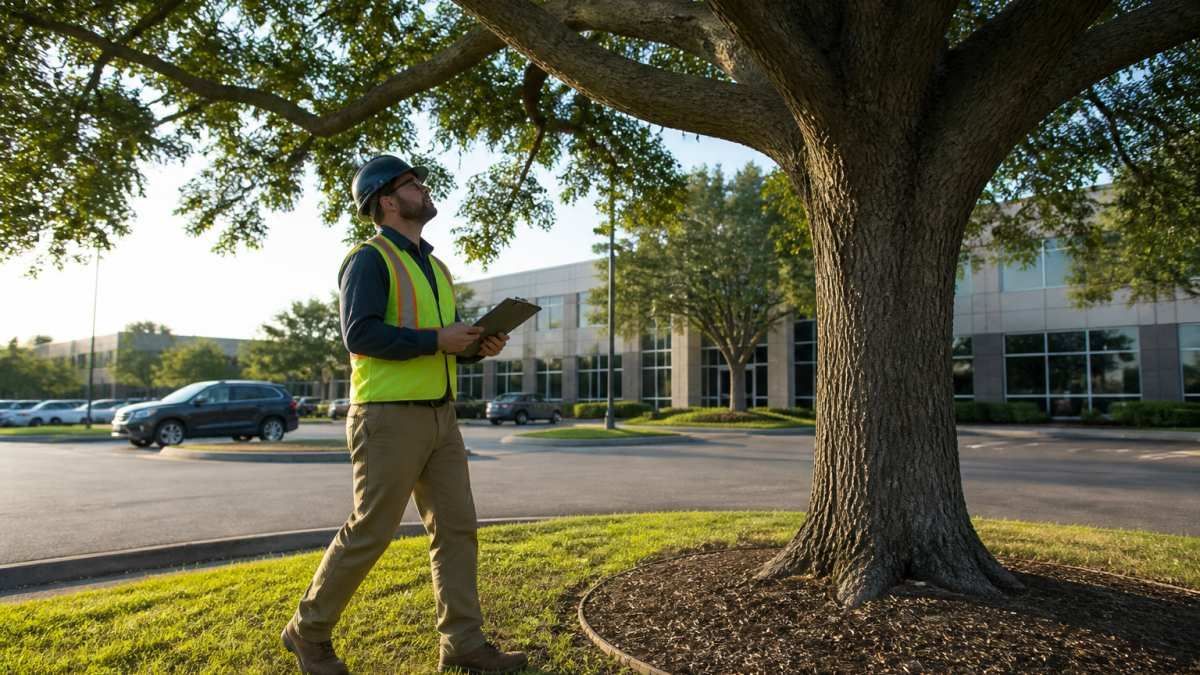
What to look for on each pass:
- Deadwood in the canopy, which is the first sign of stress
- Cracks or cavities in the trunk and major limbs
- Lean that has changed since the last visit
How Often Should Commercial Properties Schedule Tree Inspections?
Most commercial properties should schedule a professional tree inspection once a year, plus a quick check before storm season. High-traffic sites, older trees, and properties with past storm damage need closer attention.
Inspection frequency depends on risk, not square footage. Keep a written record of each inspection so you can spot changes over time and prove your care if a claim comes up.
Your Commercial Tree Service Checklist for Every Season
Tree care splits into two halves: the growing season, when you watch and protect, and the dormant season, when you cut and correct. A commercial tree service checklist should follow that rhythm.
| Season | Main Focus | Key Tasks |
|---|---|---|
| Spring | Growth and pests | Inspect new growth, watch for pest activity, clear deadwood |
| Summer | Storm prep | Check for weak limbs, thin the canopy, plan storm response |
| Fall | Structure | Remove deadwood, assess lean, schedule dormant pruning |
| Winter | Corrective pruning | Prune while dormant, remove hazardous trees, plan next year |
Spring and Summer: Growth, Pests, and Storm Prep
Spring shows you what trees survived: watch for late leaf-out, thin canopies, and pest activity. Upstate summer storms arrive fast, so thin crowded canopies before they become sails in high wind.
Fall and Winter: Deadwood, Structure, and Dormant Pruning
Dormant pruning is the workhorse of commercial tree care. With leaves down, crews see branch structure clearly and make cleaner cuts, and fall deadwood removal means less debris after winter storms.
Building a Tree Maintenance Plan for Property Managers
A tree maintenance plan for property managers is a written schedule listing every tree, its condition, and the work it needs over the next year.
A list of tree names is not a plan; a plan assigns each tree an ID, a risk score, a work order, and a review date, which lets you coordinate crews, justify spending to ownership, and prove you acted reasonably if a claim arrives.
Step 1: Build a Tree Inventory
Start with a simple inventory sheet, in a spreadsheet or asset-management tool. For each tree, record:
- Tree ID , a unique number, paired with a tag or a mapped pin
- Species , if unknown, note leaf shape, bark, and canopy form for later identification
- Size , trunk diameter at chest height and approximate height
A property with 40 trees can be inventoried in one walk-through; a larger portfolio may take a few visits, but the sheet becomes the backbone of every decision that follows.
Step 2: Score and Prioritize Risk
Risk is a product of likelihood and consequence. A tree with a large dead limb over a busy entrance outranks one with the same defect over an empty rear lot, even if the second looks worse.
A simple three-tier system works for most commercial sites:
| Priority | Criteria | Response Window |
|---|---|---|
| High | Defect present, target is occupied or high-traffic | Inspect immediately; schedule work within days |
| Medium | Defect present, target is low-traffic or property-only | Schedule within the current season |
| Low | No significant defect, target is open ground | Monitor at the next routine inspection |
Document the reasoning behind each score. If a tree is downgraded, note why. That note is your record of a deliberate decision, not neglect.
Step 3: Set the Calendar by Season and Species
The calendar should reflect both the property's risk profile and the trees' growth habits:
- Late winter (dormant season) , structural pruning for most deciduous hardwoods; removals of hazardous trees are often easier before spring growth
- Spring , inspect for pest emergence, disease symptoms, and late leaf-out; avoid heavy pruning on species that bleed heavily in spring
- Summer , storm-season checks, canopy thinning on dense trees, and monitoring of previously flagged defects
Species matter. Flowering trees that bloom on old wood are typically pruned after bloom, while many shade trees are best pruned in dormancy. If unsure, ask the provider to confirm timing before the work order is issued.
Step 4: Review and Update After Every Event
The plan is a living document. Update it after every inspection, storm event, and completed work order. A short annual review before budget season lets you roll forward deferred work and flag trees that have changed condition.
Coordinating Multiple Sites
If you manage more than one property, keep the inventory format identical across sites. A shared tree ID scheme, common risk scale, and consistent inspection form let you compare sites, batch work orders, and give ownership one summary instead of a stack of reports.
At Arbortech of Anderson, we have worked with property managers across Anderson, Greenville, and the surrounding communities since 2008, and we are glad to review an existing inventory or help build one during a site walk.
Identifying Hazardous Trees Before They Become a Liability
Hazardous trees have a defect that could cause a limb or the whole tree to fail and hit something valuable. Spotting them early is the cheapest risk mitigation there is.
Warning signs we look for:
- Mushrooms or conks on the trunk or roots
- Deep cracks or splits in the main stem
- Hollow sections or soft wood
When a tree shows two or more of these signs, call a professional for a tree risk assessment. Do not wait for the next storm to make the decision for you.
Never let a crew top a large tree to "reduce the risk." Topping forces weak regrowth that fails more easily in wind. Proper pruning removes the hazard, not the whole crown.
Commercial Tree Care Services: What a Full-Service Provider Handles
Full commercial tree care services cover inspection, pruning, health treatment, removal, and emergency response under one contract. That single point of contact matters when a storm hits at night.
A complete scope usually includes:
- Tree trimming and pruning for canopy management and clearance
- Tree health assessment and disease management
- Hazardous tree removal and safe takedowns near structures
With one provider for all of it, nothing falls between two contractors. That is how we work at Arbortech of Anderson, and why property managers in Anderson and Greenville keep us on their vendor list.
Budgeting and Vendor Selection for Commercial Tree Maintenance
Commercial tree maintenance pricing depends on tree count, size, access, and how much risk you carry. There is no honest flat rate, so treat any quote that skips a site visit with suspicion.
The number comes from the site, not the phone. Understand the cost drivers, build a budget range, and know which questions separate a real commercial provider from a residential crew with a truck.
What Drives Commercial Tree Maintenance Cost
Every estimate is built from a handful of variables. Understanding them lets you compare quotes fairly and spot a scope too thin to be safe.
- Tree count and size , more trees and larger diameters mean more crew time, more rigging, and more debris handling
- Access , a tree in an open field is faster to work than one wedged between a building, a fence, and a parking deck
- Proximity to targets , work over cars, walkways, or roofs requires rigging, traffic control, and sometimes a crane or lift
A quote that lists a single lump sum without a scope is hard to compare. Ask for the scope in writing: which trees, what work, what debris handling, and what is excluded.
Building a Budget Framework
You do not need a precise number to budget, you need a structure. A common approach separates spending into three buckets:
- Routine maintenance , scheduled inspections and pruning, planned annually
- Hazard mitigation , removal or correction of trees flagged as high or medium priority
- Emergency reserve , a contingency for storm response and after-hours calls
Fund the routine bucket first, because it keeps the hazard bucket from growing. A property that inspects and prunes on schedule typically faces fewer emergency removals than one that waits for failures.
When you review the plan annually, roll deferred work forward and re-rank it. A medium-priority tree that has declined may move to high priority and should be funded before new low-priority work.
Vendor Selection Checklist
Ask every provider the same questions and compare the answers side by side:
- Insurance , are you insured, and can you provide a certificate of insurance naming the property? Confirm both general liability and workers' compensation.
- Crew , who performs the work, are they trained, and are they employees or subcontractors?
- Emergency response , how do you handle after-hours calls, and what is the response window?
Get at least two estimates and compare scope, not just the bottom line. A cheap quote that skips the hazard assessment, the debris handling, or the insurance certificate is not a bargain; it is a risk transfer you did not agree to.
Property managers juggling multiple sites who need one reliable crew for routine pruning, hazard removal, and after-hours storm response, with written scopes and reporting that hold up at budget review.
A Note on Contracts
For recurring work, a written maintenance agreement is worth more than a handshake. It should state the inspection frequency, the work included, emergency response expectations, and how scope changes are priced.
If you are comparing providers in Anderson, Belton, Clemson, or anywhere across the Upstate, we are happy to walk your site, review your inventory, and put a written scope in front of you.
Conclusion
The hardest part of commercial tree maintenance is not the work itself. It is deciding to stop reacting and start planning.
If you own or manage property in Anderson, Belton, Clemson, or anywhere across the Upstate, we can walk your site, rank the risks, and build a plan that fits your budget.
Contact us for an estimate and get your trees on a schedule before the next storm sets it for you.
Frequently Asked Questions
How often should commercial properties schedule tree inspections?
Most commercial properties benefit from at least one full inspection per year, ideally in late winter or early spring before storm season. Properties with mature trees, recent construction, or a history of storm damage should schedule inspections twice a year. After any major storm, bring in a professional for a follow-up assessment. A commercial tree inspection checks trunk condition, branch structure, root stability, and deadwood, so problems get caught before they turn into liability claims or emergency removals.
What should a commercial tree maintenance plan include?
A solid tree maintenance plan for property managers covers inspection frequency, pruning schedules by species, pest and disease monitoring, storm preparation steps, and a budget line for both routine and emergency work. It should also list every tree on the property with its location and condition, define who is responsible for each task, and set a review date. Pair the plan with a commercial tree service checklist so nothing gets skipped between visits.
How can property managers identify hazardous trees?
Watch for dead branches in the canopy, cracks or hollows in the trunk, mushrooms at the base, leaning that has worsened over time, and roots that are exposed or damaged. Trees with included bark, where two trunks grow too closely together, are also a risk. A professional commercial tree inspection confirms what you are seeing and ranks the risk. Hazardous tree removal should happen before storm season, not after damage occurs.
What should you ask before hiring a commercial tree service?
Ask for proof of insurance, including general liability and workers' compensation, and confirm the crew has experience with commercial properties, not just residential yards. Request references from similar sites and ask how they handle emergency calls during storms. Get a written scope of work that lists exactly what will be pruned or removed. A provider that has served the area for years, like Arbortech of Anderson since 2008, can also speak to local tree species and storm patterns.